Why Classroom Culture Comes Before Classroom Management: Build the Classroom You Actually Want to Teach In
Jun 27, 2026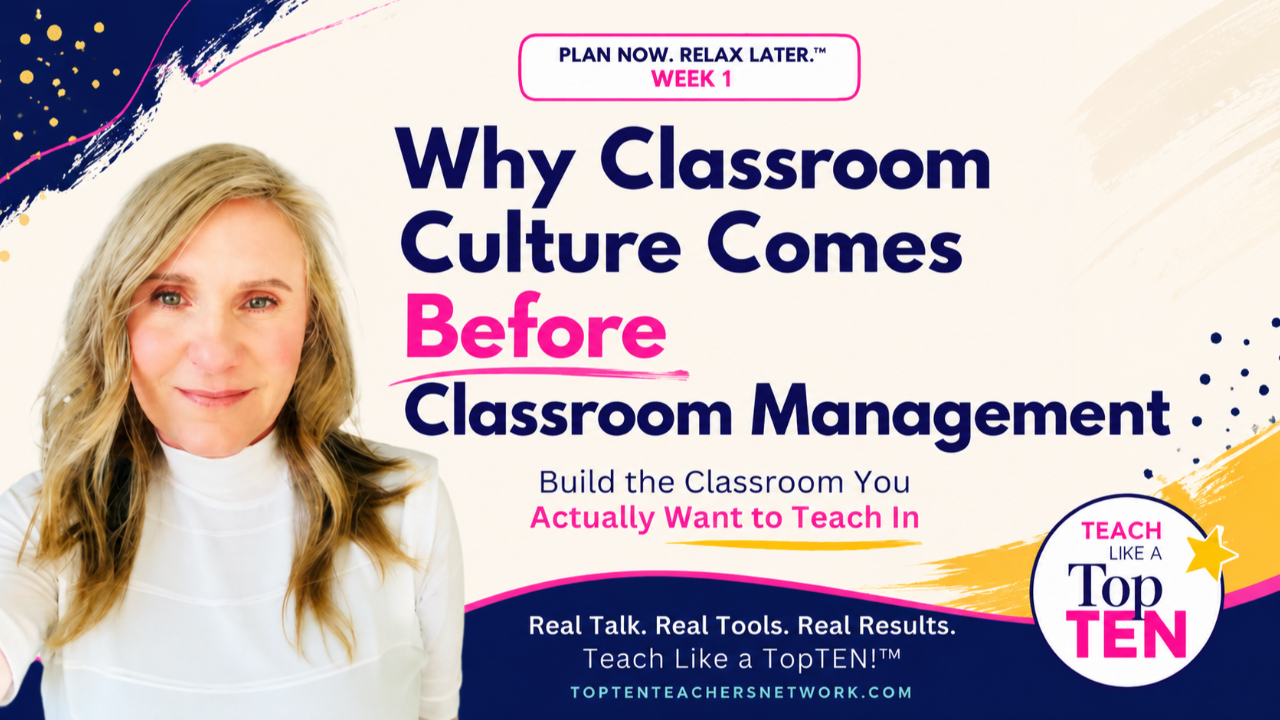
PLAN NOW. RELAX LATER.™ • WEEK 1
Build the Classroom You Actually Want to Teach In
Why classroom culture comes before classroom management.
There were multiple points in my teaching career when I seriously questioned whether I wanted to stay in education.
I loved teaching. But the struggle was real.
There were days when I would catch a glimmer of what teaching could be—the connection, the learning, the moments that made all of the work feel worth it.
But every year, by the time we got down to the real academics in mid-September, I was already in survival mode.
At the time, I taught fifth grade, and the teacher next door taught fourth. She was a master at compliance and, quite frankly, scare tactics.
And I thought I wanted to be like her.
I thought that was what good classroom management looked like.
And eventually? I got pretty good at it too.
My students complied. I could control a room. Expectations were followed.
But I had mistaken compliance for great teaching.
I didn’t know it yet, but getting kids to do what I said was nowhere near the highest level of teaching.
Kids are hard today, but they were hard then too. In fact, my school was known for having a challenging student population. And without even realizing it, I walked into my classroom with my guard already up.
I was prepared to manage students before I had ever really learned how to build a classroom with them.
So I did what a lot of hardworking teachers do.
I spent nights planning, weekends catching up, and far too much time trying to figure out why my classroom still felt harder than it should.
I cared deeply. I showed up. I gave everything I had.
But for a long time, I was constantly reacting instead of intentionally leading.
I was managing behavior, repeating expectations, fixing problems, and trying to hold everything together with more effort.
I didn’t need another classroom management trick.
I needed to understand what I was actually building.
Most Classroom Struggles Are Not Behavior Problems First
This was one of the biggest lessons I had to learn the hard way.
For years, I thought the answer was better classroom management.
More reminders. More consequences. More strategies. More teacher effort.
Basically, I kept trying to get better at managing what was already happening.
But the longer I taught, the more I realized I was often trying to solve the wrong problem.
Most classroom struggles are not behavior problems first. They are classroom culture problems first.
And when I say culture, I am not talking about bulletin boards, cute labels, matching bins, or a perfectly decorated classroom.
I mean what it actually feels like to be a student in your room every single day.
- How students enter and move through the room.
- How they talk to you and to one another.
- How they participate and contribute.
- What the expectations look and sound like in action.
- Whether students feel like the classroom belongs to them too.
- How much ownership they are expected—and taught—to take.
That is classroom culture.
It is built in the routines, the relationships, the language, the expectations, and the hundreds of little experiences students have in your room.
And whether we mean to or not, we are always building it.
The only question is whether we are building it intentionally.
BUILD IT INTENTIONALLY
Want a framework for building the classroom you actually WANT to teach in?
Build Your Classroom™ walks you through the decisions that shape your culture before you are stuck reacting to it.
EXPLORE BUILD YOUR CLASSROOM™ →The Mistake I Kept Making
I used to jump straight into planning.
The bins. The labels. The bulletin boards. The first-week activities. The materials. The routines. The Pinterest boards. And, obviously, the Target runs.
And listen, I love a good Target run as much as the next teacher.
But none of that answers the most important question:
What are you actually trying to build?
Before we plan another activity or buy another container, we need to look honestly at the classroom we just lived through.
- What worked?
- What didn’t?
- What drained me?
- What did I spend way too much time doing for students?
- What do I absolutely refuse to repeat?
- What kind of classroom do I actually WANT to teach in?
Because a stronger classroom is not going to come from a better theme, prettier labels, or one magical first-week activity.
It comes from making more intentional decisions about how students will participate, contribute, connect, and take ownership from the very beginning.
Culture First.
Behavior Second.™
Reflection Before Reaction
This is exactly why BUILD YOUR CLASSROOM™ starts with reflection.
Not because reflection magically fixes a classroom.
But because you cannot intentionally build something different if you have never stopped to figure out what needs to be different.
Otherwise, we do what teachers are very good at doing.
We start planning.
We find new activities. We rewrite the routines. We organize the room. We make another list.
And then September comes, and somehow we end up recreating many of the same patterns we were trying to leave behind.
So before you plan another routine, activity, or lesson, start here:
Ask yourself:
- What classroom patterns do I not want to repeat next year?
- Where did students rely on me for things they could have learned to do themselves?
- Which routines actually made our classroom work better?
- Where were my expectations strong—and where did my follow-through fall apart?
- When did students have real opportunities to talk, contribute, and make decisions?
- Where could I have handed more ownership back to them?
This is not about beating yourself up over what did not work.
It is about being willing to look at it long enough to make a different decision next time.
Because stronger classroom culture starts long before the first student walks through the door.
It starts with deciding what you want that classroom to become—and then building toward it on purpose.
REFLECTION IS THE START
Now Build Something Different.
Once you know what you don’t want to repeat, you can start deciding what you want instead. Build Your Classroom™ gives you the frameworks to intentionally build the routines, relationships, expectations, participation, and student ownership that shape your classroom every day.
BUILD MY CLASSROOM →The 3 Success Pillars™
Eventually, I realized that the strongest decisions I was making in my classroom kept coming back to the same three things.
Student Voice. Relationships. High Expectations.
Those became what I now call the 3 Success Pillars™—and today, everything I build inside TopTEN moves through these three lenses.
Because before I add a routine, plan an activity, change an expectation, or introduce something new, I want to know:
What is this actually building?
Pillar 1
Student Voice™
Are students doing more than following directions? Are they talking, contributing, making decisions, solving problems, reflecting, leading, and taking real ownership of their learning and their classroom?
Pillar 2
Relationships™
Are students getting repeated opportunities to know one another, work with different classmates, listen, contribute, collaborate, and see themselves as an important part of our classroom community?
Pillar 3
High Expectations™
Am I expecting students to think, participate, persevere, follow through, solve problems, and do more for themselves instead of automatically stepping in and doing it for them?
These three pillars completely changed the way I looked at my classroom.
They changed how I planned.
They changed how I taught routines and expectations.
They changed how I designed lessons, structured student talk, built classroom jobs, handled transitions, and thought about student leadership.
Even the first few minutes of the day started to look different.
Because I stopped asking only:
“How do I get students to do this?”
And I started asking better questions.
How can students take more ownership here?
How can this strengthen our relationships?
What can I expect students to learn to do for themselves?
That is when my classroom stopped feeling like a collection of disconnected strategies I was constantly trying to manage.
It started feeling intentionally built.
You Don’t Have to Fix Everything at Once
Once you start reflecting, it can be very easy to make a list of approximately 47 things you want to change.
Ask me how I know.
But trying to overhaul your entire classroom at once usually leads to one thing:
More work for you.
Instead, inside Build Your Classroom, I have teachers look at five Classroom Impact Areas™ and choose one or two places where a more intentional decision could make the biggest difference.
- Routines & Structures™ — How students arrive, transition, use materials, get help, move through the room, and handle everyday classroom responsibilities.
- Student Ownership™ — Where students can lead, make decisions, solve problems, reflect, collaborate, and do more for themselves.
- Classroom Culture™ — How students build relationships, participate, contribute, feel known, and become part of the classroom community.
- Engagement & Instruction™ — How students talk, think, participate, work together, struggle productively, and reflect on their learning.
- Teacher Follow-Through™ — How clearly expectations are taught, reinforced, revisited, and followed through with consistently.
You do not need to rebuild everything tomorrow.
Find the place that is costing you the most time, creating the most friction, or keeping students from taking the ownership you know they are capable of.
Start there.
Make one intentional decision.
Teach it. Practice it. Follow through.
Then build from there.
Strong classrooms are built one intentional decision at a time.
One routine. One expectation. One conversation. One student experience. One more opportunity for students to take ownership.
Start With One Question
You do not need a new planner, a three-hour meeting with yourself, or a color-coded spreadsheet to start this work.
Grab a notebook and answer one question:
What classroom pattern do I absolutely not want to repeat next year?
Then get specific.
Maybe transitions took forever.
Maybe students asked you questions they were perfectly capable of answering themselves.
Maybe the same few students did all the talking.
Maybe you spent half the day reminding everyone what they were supposed to be doing.
Maybe students worked beside one another all year but never really became a community.
Maybe you knew exactly what you expected—but your follow-through was inconsistent.
Whatever comes to mind, don’t make excuses for it.
And don’t beat yourself up over it either.
Just name it.
Because once you can name the pattern, you can start making different decisions.
That’s where intentional building begins.
TEACH LIKE A TOPTEN™
Classroom Culture Does Not Begin When Students Arrive
It begins with the decisions you make before they ever walk through the door.
How will students talk and participate? How will they learn about one another and build relationships? How will expectations be taught through what students are actually doing—not simply explained to them?
Those student experiences become your classroom culture. And the more intentionally you build them from the beginning, the less time you spend trying to manage them later.
Instead of asking,
“How am I going to manage this class?”
Start asking,
“What do I want students to experience, learn, and eventually own in this classroom?”
BUILD IT FIRST. MANAGE IT SECOND.™
Do Not Just Prepare Your Room.
Build Your Classroom.
Build Your Classroom™ helps you make the intentional decisions that shape how students participate, connect, contribute, take ownership, and learn together from the very beginning.
Build your classroom around:
✓ A clear vision for your classroom community
✓ Routines and structures students can learn to own
✓ Teacher language that builds responsibility instead of dependence
✓ Lessons that get more students talking, thinking, and participating
✓ Expectations taught through real classroom experiences
✓ Student voice, relationships, leadership, and ownership
✓ An intentional plan for your First 3 Days
Instead of walking into the school year with a decorated room and three days of activities, walk in knowing what you are building, what students will experience, and how you are going to begin.
Build the classroom you actually WANT to teach in.
BUILD MY CLASSROOM →Get immediate access plus a complimentary trial month inside the Teach Like a TopTEN™ Community.
NOT READY FOR THE FULL COURSE?
Start With Teach Like a TopTEN™
Join the free newsletter for honest classroom conversations, culture-first thinking, teacher language, and ideas for building more student voice, stronger relationships, and higher expectations into the everyday classroom experience.
JOIN THE FREE NEWSLETTER →Keep Building
Classroom culture is built through the experiences students have again and again. Keep going with these teacher favorites:
01 The One Ritual That Transformed My Classroom Culture
02 How One 15-Minute Weekly Habit Transforms Classroom Behavior and Culture
03 Classroom Organization That Builds Community—Not Just a Pretty Room

ABOUT SARAH
I Spent Years Trying to Manage What I Had Never Intentionally Built
I’m Sarah Legault, founder of the Teachers Empowerment Network, instructional coach, and veteran educator.
And much of what I teach today came from learning the hard way that getting students to comply is not the same thing as building a strong classroom.
Everything I teach now comes back to one belief:
Culture First. Behavior Second.™
That does not mean behavior does not matter.
It means I would rather teach students how to participate, contribute, work together, solve problems, take responsibility, and meet high expectations than spend the year reacting when they do not.
That is why my work is built around the 3 Success Pillars™: Student Voice, Relationships, and High Expectations.
They are the lenses I use to think about the everyday experiences that shape a classroom—from how students enter and talk with a partner to how they transition, reflect, collaborate, take ownership, and contribute to their community.
Real Talk. Real Tools. Real Results.
If you are tired of collecting classroom-management ideas and still feeling like you are doing all the work, you are in the right place.
Build the classroom you actually WANT to teach in.
Some links in this post may be affiliate links, meaning I may earn a small commission at no additional cost to you. I only share classroom tools and teacher resources I have personally used or genuinely believe can contribute to stronger classroom experiences.
Copyright © Education Reimagined, LLC. All Rights Reserved.