Classroom Organization That Builds Culture
Jan 14, 2026

Classroom Organization • Student Ownership
Classroom Organization That Builds Community Not Just a Pretty Room
A beautiful classroom may catch students’ attention.
A classroom designed for them helps them belong, contribute, and take ownership.
For almost 20 years, I started dreaming about my classroom the minute school let out.
The theme. The colors. The feeling I wanted students to have when they walked through the door on that very first day.
Sometimes I leaned a little too girlie—tropical themes, polka dots, and plenty of color. But it always came from genuine excitement about creating a classroom that felt fresh, welcoming, and ready for a brand-new group of students.
By the end of July, I was waiting for the custodians to give us the green light after waxing the floors. The minute they did, I was there. I went in early, before the rush of teachers arrived, so I could work without feeling hurried or distracted.
I always started the same way: wiping down shelves, occasionally repainting them, and refreshing bulletin boards with clean backdrops and colorful—but never over-the-top—borders.
A clean, blank slate.
I intentionally left bulletin boards empty before students arrived because I wanted us to fill them together. With my checklist in hand and labels prepped from the comfort of my home, I worked through the room a little at a time while imagining how students would learn, interact, and grow there.
What Took Me Years to Realize
Many classrooms are beautifully organized… but they are not actually functional for students.
That is the real problem.
When classroom organization is designed primarily for the teacher, students remain dependent. Materials are placed for adult convenience. Routines require constant reminders. Directions have to be repeated. Classroom structures only work when the teacher is directing every move.
And that is exhausting!
Not because you’re doing anything wrong—but because too much of the classroom still depends on you.
The community also struggles to grow when students do not feel a sense of ownership.
They are in someone else’s room.
But when classroom organization moves from my classroom to our classroom, everything changes.
Leadership begins to emerge—even from students who may have struggled to find their place before.
Organization becomes more than storage.
It becomes part of the foundation of your classroom community.
That transformation began for me when I stopped asking:
“How do I want my classroom to look?”
And started asking two better questions:
How will students easily access this?
How does this serve them—not me?
Those two questions transformed my classroom from a room students simply entered into a space they helped shape, use, and own.
Organization With a Purpose
The Philosophy Behind Classroom Organization That Actually Works
Organization should serve students—not simply make the classroom look finished.
Classroom organization is not about how the room looks when no one is in it.
It is about how the classroom functions when everyone is in it.
Students should be able to:
Access materials independently without asking permission
Move through familiar routines without constant reminders
Uphold shared expectations without repeated directions
When students cannot independently use the classroom, the room may be organized—but it is still organized around the teacher.
A student-centered classroom makes learning, materials, expectations, and routines visible and accessible.
Students do not simply follow the classroom structures.
They help uphold them. They have buy-in.
When Organization Serves Students:
- Student voice increases because students can make decisions and contribute
- Relationships strengthen through shared responsibility
- Independence grows because students know what to do and where to find what they need
- The classroom stays organized because students help maintain it
That is the difference between my classroom and our classroom.
This was the lesson I learned over time: the simplest changes in a classroom can completely change how students experience it.
When students feel trusted, they rise. When they feel respected, they begin to return that respect. When they understand how the classroom works, they are better able to participate, contribute, and lead.
And when the classroom belongs to everyone, community is no longer something the teacher has to manufacture. It is something students help build.
Keep It Simple
Fewer Structures. Stronger Routines.
This is where many well-meaning teachers get tripped up.
Too many bins. Too many procedures. Too much mine.
Teacher-Owned
My desk.
My scissors.
My pencils.
Community-Owned
Our classroom.
Our supplies.
Our responsibility.
Do you feel the difference?
The more complicated the classroom becomes, the more students depend on the teacher to keep every part of it running.
Strong classrooms rely on a small number of intentional structures that are taught, practiced, and used consistently.
- Students understand what is expected
- Transitions become more efficient
- Leadership and independence increase
- The teacher is no longer responsible for managing every move
Consistency builds confidence—and confident students are more willing to participate, contribute, and take ownership.
Choose With Intention
The Organizational Structures That Matter Most
You do not need a separate procedure for every possible classroom moment.
You need clear structures for the moments students experience every day.
A classroom structure should:
- Reduce unnecessary interruptions
- Increase student independence and leadership
- Support responsibility and shared ownership
- Make the classroom easier for students to use
If a structure does not make the classroom more accessible, independent, or student-owned, it does not earn space in your plan.
The most effective classrooms are organized around function—not themes, subjects, or aesthetics.
And yes, your classroom can still be beautiful.
But beauty should support the student experience—not become the student experience.
When classroom structures are built intentionally, they support attention, ownership, relationships, and learning throughout the day.
Intentional Structure No. 1
Attention, Flow, and Knowing What Comes Next
Because without students’ attention, nothing else works.
Before students can work independently, they need to know:
Where should I focus?
What should learning sound like right now?
What is coming next?
That starts with clear, consistent communication.
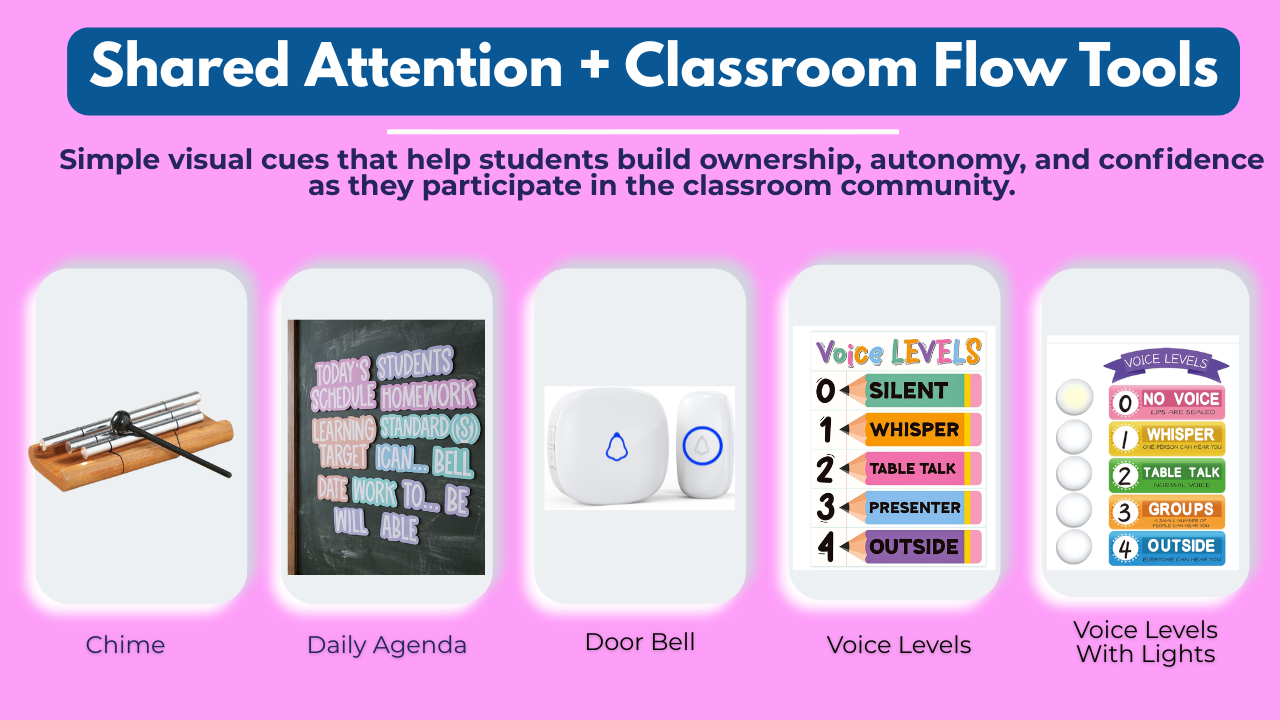
Every effective classroom I have taught in or coached includes three essentials:
- A simple, consistent attention signal
- Shared language for voice levels
- A visible daily agenda, including learning targets students can actually use
Whether you use a call-and-response, visual cue, hand signal, chime, or countdown, the key is the same:
Clear. Neutral. Consistent.
Start the year with one or two signals. Model them, practice them, reflect on them, and revisit them throughout the day until students know exactly what to do.
I always loved using a chime and a simple countdown. I might say:
“All right, fifth graders. Let’s be ready on the rug when I get to one. Ready? On the rug in five, four, three... ready in two... and one.”
Some of the more elaborate call-and-response ideas are fun, but in my experience, they rarely work better than a tried-and-true countdown that has been explicitly taught and practiced.
When I taught fifth grade, I never owned a classroom doorbell —in a classroom! But I have seen them used seamlessly, and they certainly get students’ attention.
The tool matters less than the consistency behind it. When students know exactly what the signal means and how to respond, you no longer have to compete for their attention or repeat yourself over and over.
Voice Levels Give Students a Shared Language
Students also need to understand what learning should sound like in different moments. Independent work, partner conversations, table collaboration, and whole-group discussion should not all sound the same.
A visible voice-level poster gives everyone the same language and keeps the current expectation easy to reference.
For an even more visual option, light-up voice-level signs allow students to see the expectation with one quick glance, without interrupting the learning to announce it again.
But no poster or light will do the teaching for you. Invite students to help define what each level sounds like and decide which level best supports different types of learning. Then practice using the levels in context and reflect together on whether the volume helped everyone participate and learn.
Instead of repeatedly saying, “You are too loud,” you can say:
“We are working with partners right now. Show me what our partner voice sounds like.”
Voice levels are not about keeping students silent. They give students a shared way to think about how their voices support participation, collaboration, and everyone’s ability to learn.
A visible daily agenda matters just as much. Students should not need to repeatedly ask, “What are we doing next?”
Predictability reduces uncertainty.
Clear communication builds trust.
Strong classroom flow protects learning time.
But here is what many classroom agendas miss:
A strong agenda does not only answer, “What is next?” It also answers, “What do I do when I am finished?”
Two Agenda Sections That Change Everything
What We Do When We’re All Through
This one section can prevent much of the wandering, calling your name, and off-task behavior that happens when students finish at different times.
List two to four meaningful options, such as:
- Read or respond to reading
- Complete a reflection or exit ticket
- Finish incomplete work
- Choose from a choice board or learning menu
- Complete a classroom job or enrichment activity
Then teach students how to use it.
Never hang something on the wall and expect it to work on its own. Introduce it. Model it. Practice it. Revisit it.
Ask 3 Before Me
This routine builds independence while reducing unnecessary interruptions.
- Check the agenda, directions, or anchor chart
- Ask classmates for clarification
- Use an available classroom resource
When students know the process, they can use it. When they do not, every question comes directly to you.
The key is helping students understand why each routine exists.
Clear routines reduce confusion, strengthen independence, and protect learning time.
Intentional Structure No. 2
Student Access and Ownership
Because independence builds confidence.
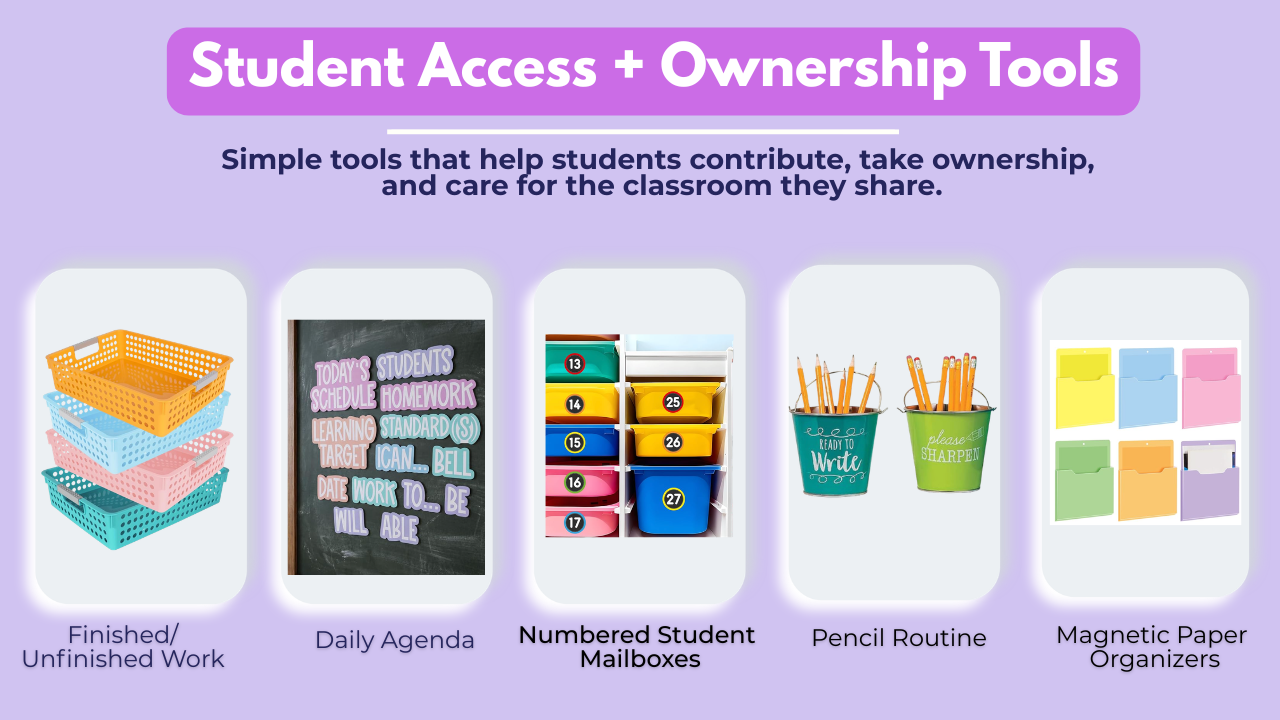
If students use something every day, they should be able to find it, use it, and return it without asking.
Student ownership begins when the classroom is organized in a way students can understand. Materials need a clear home. Finished and unfinished work need consistent destinations. Daily information needs to be visible. Students should not have to rely on the teacher for every pencil, paper, direction, or next step.
A Simple Pencil Routine
One container labeled Sharpened.
One container labeled Needs Sharpening.
Students place one pencil in, take one out, and return to learning. Sharpening and restocking can become a student responsibility instead of an interruption during instruction.
See the Sharpened and Needs Sharpening Pencil BucketsNow think about the materials, information, and student work that move through your classroom every day.
Organize the daily agenda into clear visual sections so students can quickly see what is happening now, what comes next, and what they need.
Create an accessible location for frequently used papers, take-home materials, absent work, or resources students need throughout the day.
Give students a consistent place for returned work, classroom communication, and materials they are responsible for collecting.
Finished and Unfinished Work Bins
Give students clear places to submit completed work and store work they still need to finish. This keeps papers from disappearing into desks—and stops you from managing every assignment.
Other student access points may include:
- A clearly marked turn-in location for each subject or class
- Accessible manipulatives and learning materials
- A consistent location for absent-work materials
- An intentional student-led Shout-Out structure that gives students an active role in strengthening classroom community
When students do not know where materials belong, where their work goes, or what to do next, the teacher becomes the classroom’s information desk.
The goal is not to fill the classroom with more containers, labels, and organizational products. The goal is to create a small number of clear, accessible structures that students are explicitly taught how to use and help maintain.
When materials are easy to find, work has a clear destination, expectations are visible, and classroom spaces are used consistently, unnecessary interruptions decrease and student ownership grows.
Student ownership often begins with one powerful thought: “I know what to do.”
Intentional Structure No. 3
Learning in Action
Because instruction should not stop for logistics.
One of the most powerful changes I made was creating anchor charts with students—and displaying only the resources they were actively using.
I referred to those charts throughout instruction and asked:
“Where could you find a resource in the classroom to help you?”
Walls filled with resources do not automatically support learning. Students must understand what each resource means, why it matters, and how to use it.
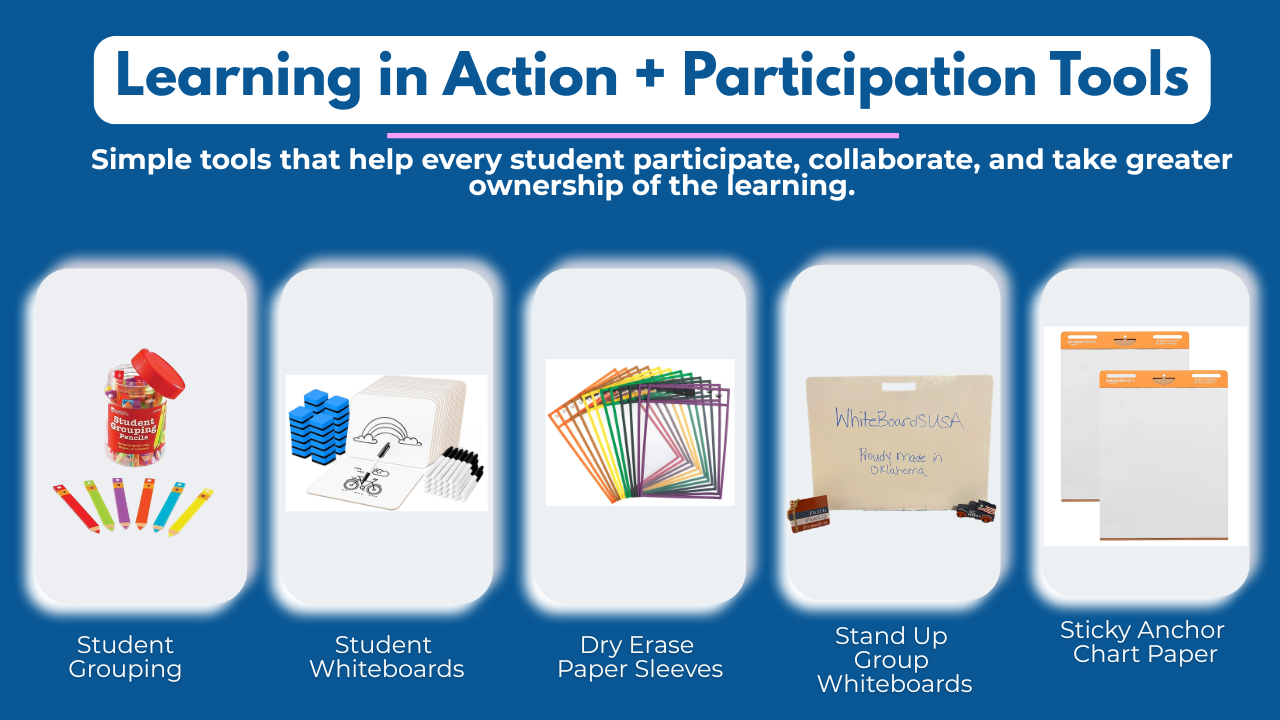
Choose tools that increase participation—not materials that simply fill the walls.
Numbered, colored, or shape-based tools make frequent partner changes simple while strengthening participation and peer relationships.
They create instant, low-risk participation and allow every student to respond. Cleaning and organizing them can become a student job.
Vertical workspaces encourage movement, collaboration, visible thinking, and productive conversation.
Use them for math practice, games, review, reflection, and reusable learning tasks. You can even do a quick random grouping of your students by color!
No complicated rotations.
Just accessible tools students understand how to retrieve, use, and return.
When participation becomes easier, more students enter the learning.
Intentional Structure No. 4
Routines and Transitions
Because transitions should be taught—not repeatedly managed.
Transitions are often where classrooms lose valuable learning time. The solution is not another reward or consequence. Students need a clear process that has been explicitly taught and practiced.
Strong transitions are supported by:
- Visual timers that make time visible
- Teacher narration that notices what students are doing successfully
- Accessible materials and predictable movement patterns
Lining up is not something students should simply be expected to know. It is a routine that must be taught.
Students need to understand:
- Where to stand
- What they should be doing
- What to do while waiting
- How the teacher will signal the next step
Teach it. Practice it. Notice it. Reflect on it. Repeat.
Predictable routines help students feel secure. Security strengthens trust—and trust supports classroom community.
Intentional Structure No. 5
Classroom Libraries and Spaces That Invite Learning
Because how students experience the space matters more than the décor.
When it comes to books, students absolutely judge by the cover. A classroom library should invite them in, help them find what interests them, and make reading feel like something they get to be part of.
Display books the way a bookstore would. Organize them in ways students understand. Then give students an active role in maintaining the space, rotating displays, recommending titles, and helping one another discover what to read next.
Keep the Checkout Simple
Name. Title. Date Out. Date Returned.
The goal is not to create another complicated system for you to manage. It is to give students a clear process they can understand, use, and help maintain.
Think beyond shelves. Build a space that makes reading visible, accessible, and shared.
Classroom Library Bins and Dividers
Organize books by genre, topic, series, author, or student-created categories so readers can find what they want without depending on you.
Front-Facing Book Display Ledges
Use front-facing displays to spotlight new books, student favorites, current topics, or titles connected to what your class is learning.
Turn book promotion into a classroom job. Students can rotate featured titles, create themed displays, or highlight books they believe classmates should read.
Create flexible places for students to read, talk about books, or work with a partner without turning the library into a space they can only use with permission.
Use them for reading, partner conversations, small groups, or collaborative work throughout the room. Mine lasted for years.
A simple visual can reinforce that reading matters here—but the strongest message will always come from the books students see, discuss, recommend, and choose.
A classroom library should not be another space the teacher has to manage. It should be a space students know how to use, care for, and help bring to life.
When students can find books independently, recommend titles, rotate displays, return materials, and help maintain the space, the library becomes more than a corner of the room.
It becomes a shared space that builds reading identity, responsibility, relationships, and community.
Intentional Structure No. 6
Jobs and Shared Responsibility
Because students take greater ownership when they meaningfully contribute.
Classroom jobs should not be another chart the teacher creates, manages, and constantly reminds students to follow.
Students should help identify the jobs the classroom needs and develop the criteria for doing them well.
Shared-responsibility structures may include:
- A clear classroom job board
- Student-managed materials and classroom spaces
- Clearly organized hall passes
- An intentional Shout-Out structure that helps students notice one another’s contributions
Responsibility builds pride.
Pride strengthens students’ connection to the classroom and to one another.
Intentional Structure No. 7
Small Joys That Build Culture
Because joy is not separate from classroom culture.
One year, I gave every student a mini succulent. Each plant was numbered, cared for, and managed by students.
A year later, one of my most challenging students returned with hers.
Thriving.
Repotted.
Still alive.
Small experiences rooted in care can become part of how students see themselves inside your classroom.
Small touches might include:
For the Teacher Behind the Classroom
My Go-To Teacher Health and Wellness Favorites
This is a separate collection of the products I personally reach for to support my health, comfort, energy, and well-being during the school year—and beyond the classroom.
Browse My Teacher Wellness Favorites
Intentional Structure No. 8
Teacher Care Matters, Too
Because you are part of the classroom experience.
Students notice how we enter the room, respond to challenges, and move through the day. The small things that help you feel prepared and supported matter.
Your teacher-care anchors might include:
- A lanyard you genuinely enjoy wearing
- A mug or cup that makes your day a little better
- An electric kettle for hot water
- A mini fridge for daily essentials
These small comforts do not replace boundaries, planning, or meaningful support. But they can make the space more functional for the teacher who spends every day inside it.
Real Talk
The Best Classroom Organization Is Simple, Useful, and Student-Owned
Less stuff.
Clearer structures.
More time for teaching and learning.
When your classroom feels complicated, do not begin by buying more.
Start by removing what students do not need.
When organization truly serves students:
- Student voice grows
- Relationships strengthen
- Independence increases
- Students help build and maintain the classroom community
Your students will feel the difference.
And so will you.
Teach Like a TopTEN™
Build More Than a Beautiful Classroom
Strong classroom culture is not created through décor, labels, or random activities. It is built through the routines, expectations, teacher language, relationships, and student ownership students experience again and again.
The room should not simply look ready for students. It should be designed so students can enter it, understand it, contribute to it, and eventually help lead it.
Instead of only asking:
“How do I want my classroom to look?”
Start asking:
“What do I want my students to experience here?”
TEACH LIKE A TOPTEN™
A Pretty Classroom Is Not the Same as a Classroom That Works
Classroom organization should do more than make supplies look neat. It should help students know where to go, what to do, how to contribute, and how to take increasing ownership of the space.
Before you label another bin or rearrange another shelf, decide what you want students to experience in the room every day.
Do not just organize
where everything goes.
Intentionally build
how everyone will use the space.
BUILD THE PLAN BEHIND THE ROOM
Do Not Just Set Up Your Classroom.
Build the Classroom.
Build Your Classroom™ helps you create a connected plan for how your classroom will look, feel, and function—before the back-to-school rush takes over.
Build an intentional plan for:
✓ Your classroom vision and community
✓ Routines and structures students can eventually own
✓ The way students use materials and shared spaces
✓ Intentional teacher language
✓ Lessons that increase participation and thinking
✓ Expectations, leadership, and student ownership
✓ Your First 3 Days Launch Plan™
You will not be handed another collection of classroom-management tricks. You will build a classroom plan around your students, your goals, and the experience you want to create.
Build it first. Manage it second.
BUILD MY CLASSROOM™ →Immediate access • 7 professional learning hours • Complimentary trial month inside the Teach Like a TopTEN™ Community
Button not opening? Open the secure checkout here.
COMING JULY 25 INSIDE THE COMMUNITY
Set Up for Community™
A 7-Day Classroom Setup Challenge
Design a classroom that does more than look good. Over seven focused days, you will build a space that helps students connect, contribute, move independently, and take greater ownership from the beginning.
✓ Plan how students will enter and use the space
✓ Organize materials for greater independence
✓ Build spaces that support connection and contribution
✓ Think beyond decorating and design the student experience
✓ Complete one focused setup move each day
Join now and be ready when the 7-day challenge begins.
KEEP BUILDING
Continue With These Teacher Favorites
Explore more ways to strengthen classroom community, student ownership, and the everyday experiences that shape how students participate and contribute.
ABOUT SARAH
Teachers Need More Than Another Classroom-Management Strategy
I’m Sarah Legault, founder of Teachers Empowerment Network, instructional coach, and former classroom teacher with more than 20 years of experience.
For the first decade of my career, I believed becoming a better teacher meant becoming better at managing behavior. Everything changed when I stopped asking, “How do I manage this?” and started asking, “What kind of classroom am I intentionally building?”
Today, I help teachers build the classroom first—through intentional routines, expectations, teacher language, relationships, learning experiences, and student ownership—so classroom management becomes the backup plan instead of the daily plan.
Culture First. Behavior Second.™
My work is grounded in the 3 Success Pillars™: High Expectations, Student Voice, and Relationships. Together, they help teachers create classrooms where students understand what is expected, know their voices matter, and take greater responsibility for the community they help build.
Real Talk. Real Tools. Real Results.
Build the classroom you actually WANT to teach in.
Some links in this post may be affiliate links, which means I may earn a small commission at no additional cost to you. I only share classroom tools and products I have personally used or genuinely believe can support teachers and students.
Copyright © Education Reimagined, LLC. All Rights Reserved.